
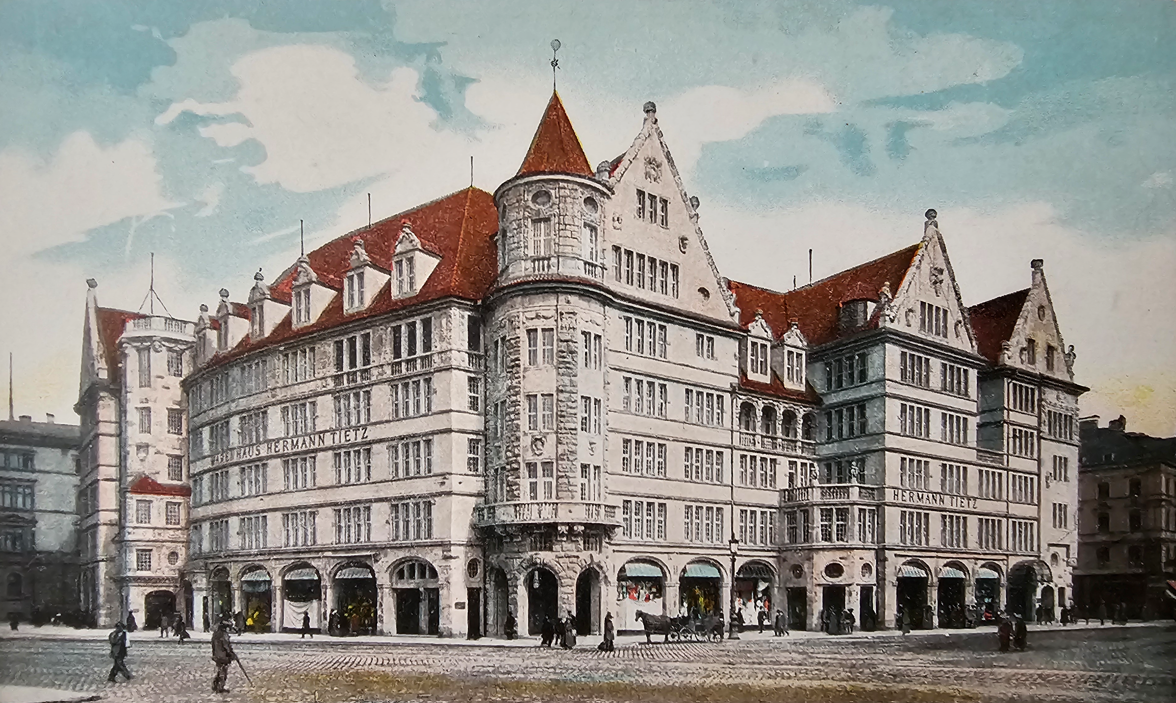
Our association member Rolf Lang has shared the results of his research on the Hermann Tietz department store in Munich with the association. Many thanks to him.
On April 16, 1889, Hermann Tietz opened a “yarn, button, trimmings, linen, and wool goods store” at Karlsplatz 23. The store’s opening was announced via a newspaper advertisement. It promoted “lowest prices,” “proven quality,” and “the largest selection, especially of new items” [1]. In addition to the store at Karlsplatz 23, there were three other branches: Rumfordstraße 1b, Theresienstraße 30, and Neuhauserstraße 32 [2]. In 1895, Oscar Tietz and his grandfather Hermann Tietz decided to move to the office building at Schützenstraße 1a [1] [2, p. 39 ff.]. Oscar Tietz had already purchased this building to provide financial security for his wife and child [3, p. 39 ff.]. As a result, all tenants immediately gave notice, as they did not want to have an office in the “Jud-Tietz-Palast.” The building on Schützenstraße still stands today—though hardly anyone knows that the Hermann Tietz department store was once located there.
Ten years after the department store opened, expansion had made another move necessary to accommodate its growth. By 1905, the new, prestigious Hermann Tietz department store had been built at Bahnhofplatz 7 as a modern temple of consumerism (see photo). The store was advertised as “Southern Germany’s largest department store for all daily necessities.” The building housed its own workshop and photography department. Following the English model, the Tietz department store featured a rooftop garden offering a panoramic view of Munich, complete with a restaurant. This success led to a significant expansion of the Bahnhofplatz 7 location in 1929 through the purchase of five neighboring buildings [1]. After the National Socialists seized power in 1933, the Tietz family was expropriated and the company name was changed to “Hertie.” Restitution took place after World War II. The claims for restitution by Georg and Martin Tietz, the sons of Oscar Tietz, as well as his son-in-law Hugo Zwillenberg, were enforced against Hertie GmbH by Munich attorney Fritz Neuland, the father of Charlotte Knobloch, President of the Jewish Community of Munich and Upper Bavaria [4, p. 258]. The department store operated under the name “Hertie” until 1994 and was then taken over by Karstadt. In 2023, the store was closed because it was no longer considered profitable. The building on Bahnhofplatz still stands today.
Sources and References
[1] Stadtarchiv München, Zeitungsausschnitte: DE-1992-ZA-04819 – Firmen – Tietz, Hermann & Co., 1889-1934
[2] Adressbuch von München 1894. Herausgegeben von der kgl. Polizei-Direktion, p. 463
[3] Georg Tietz: Geschichte einer Familie und ihrer Warenhäuser, Deutsche Verlagsanstalt Stuttgart 1965
[4] Johannes Bähr; Ingo Köhler: Verfolgt, “arisiert”, wiedergutgemacht? Wie aus dem Warenhauskonzern Hermann Tietz Hertie wurde, Siedler Verlag 2023
Image: The Hermann Tietz department store on Munich’s Bahnhofsplatz (postcard by R. Lang)